From design to validation – and closer to real-world antivirals
EvaMobs 3rd Consortium Meeting
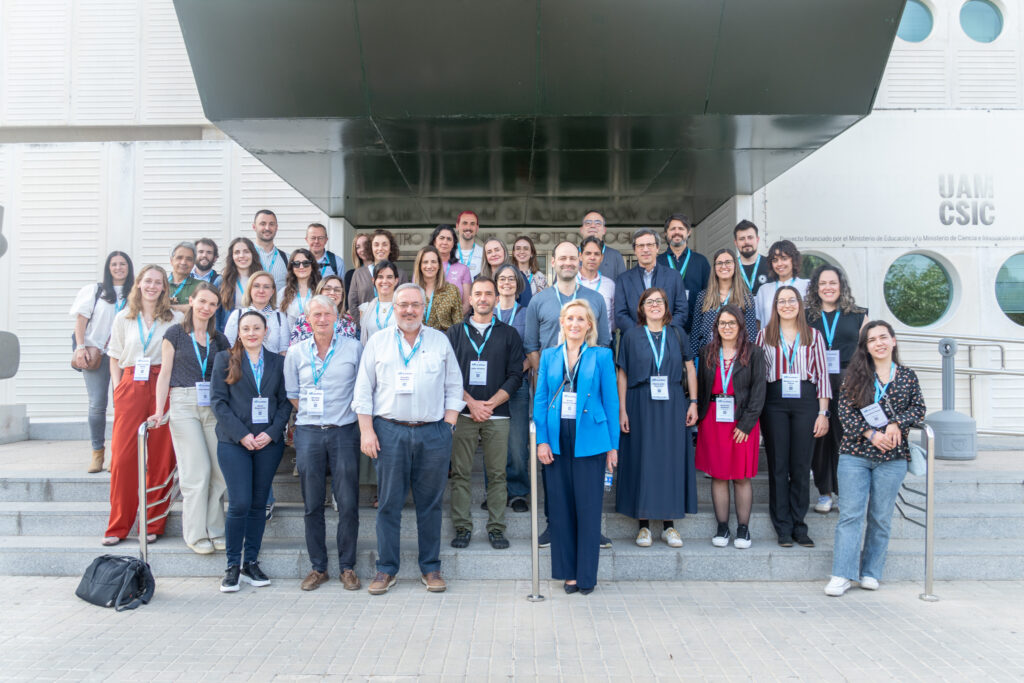
Three years into EvaMobs, we came together once again – this time in Madrid, hosted by our partners at CNB-CSIC. Over two packed days, we shared progress, connected results across disciplines, and aligned on what comes next.
What stood out most? A clear shift from early-stage exploration to validated, promising antiviral candidates.
From computational design to experimental validation
Across the consortium, we are now seeing the full pipeline in action.
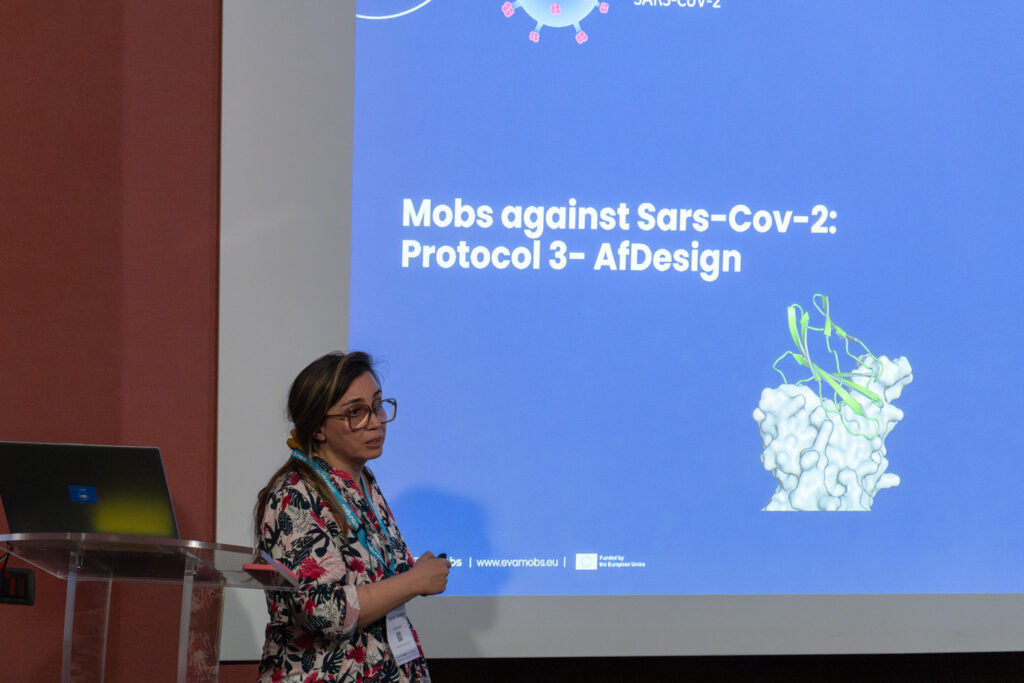
Our computational teams – led by ITQB NOVA, with key contributions from EPFL – are using AI-driven methods to design new antiviral molecules. In practice, this means using advanced computer models to predict protein structures that can attach to viruses and block them, before they are even produced in the lab. Encouragingly, these predictions are increasingly matching experimental results, showing that the designs are not just theoretical – they work in reality.
This growing maturity is something the team feels clearly. As Diana Lousa (ITQB NOVA) puts it:
“We are now at a point where our EvaMobs platform is well streamlined – from design to production, to neutralization assays and toxicity analysis. Everything is flowing very well, and there is a lot of interaction across the consortium.”
At the same time, structural biology efforts at CNB-CSIC are helping us understand how these molecules behave at the molecular level. Using cryo-EM – a technique that allows scientists to visualise proteins in near-atomic detail – the team can “see” how the designed molecules bind to viral proteins, such as the SARS-CoV-2 spike.
For José M. Valpuesta (CNB-CSIC), this progress reflects both technical and scientific advances:
“Our role is to determine the structures of these biologicals and how they interact with viral receptors. We’ve overcome some bottlenecks, and now we are getting very nice results – and I think there will be more in the future.”
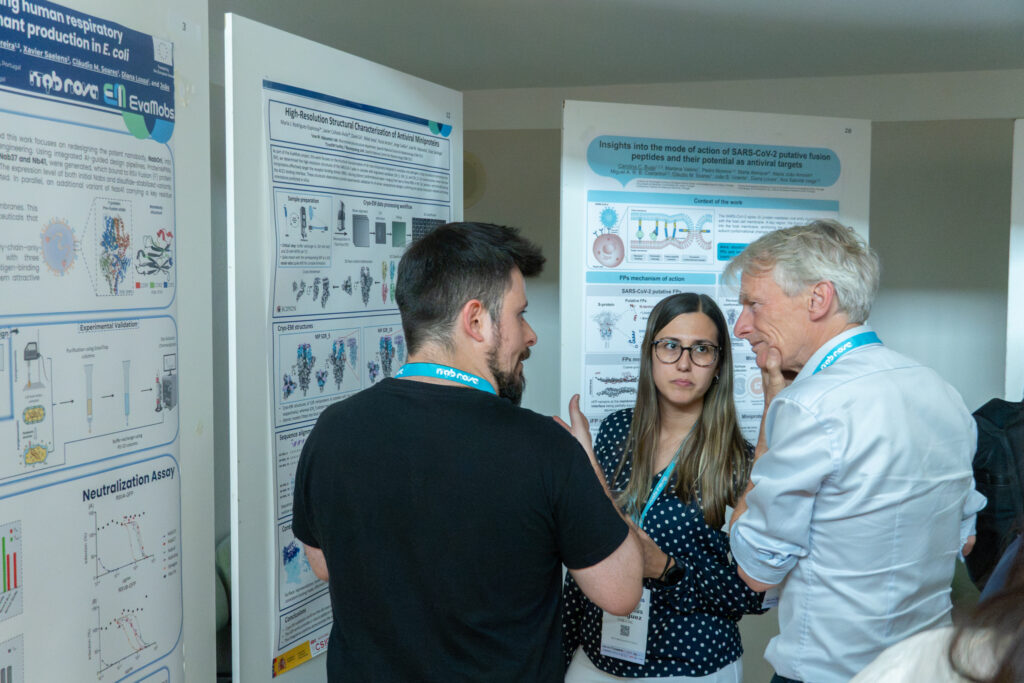
On the experimental side, partners including ITQB NOVA, NIBRT, and VIB are turning these designs into real molecules and testing them. Several candidates – particularly miniproteins (small, engineered proteins designed to bind viruses) – are showing high stability and strong binding. In simple terms, they attach tightly to the virus and remain stable under different conditions, both essential features for a potential therapy.
This reflects the scale of work already carried out. As Diana notes:
“We have tested a very large number of molecules – monobodies and miniproteins – and we already have very nice successful cases for RSV and SARS-CoV-2.” At the same time, the consortium is expanding into more challenging targets, with “new designs for Zika and Influenza, where we are a bit less advanced, but now have new ideas on how to tackle them.”
What’s working – and what we’re learning
A key strength of EvaMobs is its iterative approach: design, test, learn, and refine.
Across viral targets – including SARS-CoV-2, RSV, Zika and Influenza – teams have explored multiple strategies. While some areas are progressing faster than others, every result – positive or negative – helps improve the overall approach.
One clear takeaway so far: next to creating monobodies, also miniproteins and nanobodies are emerging as promising candidates.
This learning process is central to the project. As Diana reflects:
“Testing different strategies has been essential. Not everything works – but each result helps us refine our approach and focus on what truly has potential.”
Collaboration driving progress
The meeting once again highlighted the importance of close collaboration across disciplines.
From computational design to structural validation and experimental development, progress depends on continuous feedback between teams. A molecule designed on a computer can quickly be tested in the lab, analysed structurally, and improved – creating a highly connected pipeline.
The presence of the Scientific Advisory Board further enriched these discussions, providing external expertise and valuable perspective as the consortium moves into a critical stage of the project.
What’s next
As EvaMobs moves forward, the focus is becoming sharper – prioritisation and progression.
The next phase will centre on selecting the most promising antiviral candidates and advancing them toward pre-clinical development. This includes further validation and optimisation, with the goal of identifying the strongest candidates to move forward into a future first-in-human clinical trial.
For project coordinator Cláudio M. Soares (ITQB NOVA), this moment defines the trajectory of the project. As he explains:
“This is a turning point. We are not lacking possibilities – on the contrary, we have many. The challenge now is to decide what to take forward.”
At the same time, he highlights the broader ambition behind EvaMobs:
“What we are aiming to prove is that a streamlined platform – from protein design to production – can work in short times.”
In other words, the project is not only developing antiviral molecules, but demonstrating a new, faster way of creating them.
With strong candidates now in hand and a fully integrated pipeline in place, EvaMobs is entering a phase where its core ambition is within reach – advancing next-generation antiviral solutions toward real-world impact.